


Stay on BusinessObjects or move your BI platform. Two good answers, and everyone quoting you only sells one.
Migration vendors sell leaving. Support resellers sell staying frozen. We deliver BI 2025 upgrades and BI platform migrations, so we compare both paths against your actual estate and tell you which one fits. Even if the answer is “stay put.”
Plan my upgradePlan my BI exit
If any of this sounds like your Monday, this page is for you
“We’re on 4.3 and support is running out. If my CIO or an auditor asks for the plan, I don’t have one I’d put my name on.”
“Our BO specialist left and took fifteen years of knowledge with him. Reports break and nobody owns the fix.”
“Leadership keeps asking whether to migrate or stay. Every vendor gives a different answer, and each answer happens to match what that vendor sells.”
That last quote is the real problem. Everyone advising you has a horse in this race, except a partner who gets paid either way. We deliver upgrades and exits. That is the whole point of asking us.
the deadline is for version 4.3, not the platform. half the panic out there misses that.
The fork in the road: two paths, honestly compared
-
Stay: upgrade to BI 2025
The right call when your reports, universes, and schedules are doing their job and the only real problem is the 4.3 support clock. BusinessObjects is not dying: BI 2025 shipped in March 2025, BI 2027 is planned for early 2027, and SAP has committed to maintaining the product line into the next decade. Your content, security model, and trained users carry forward. An in-place upgrade over 4.3 is a supported path.
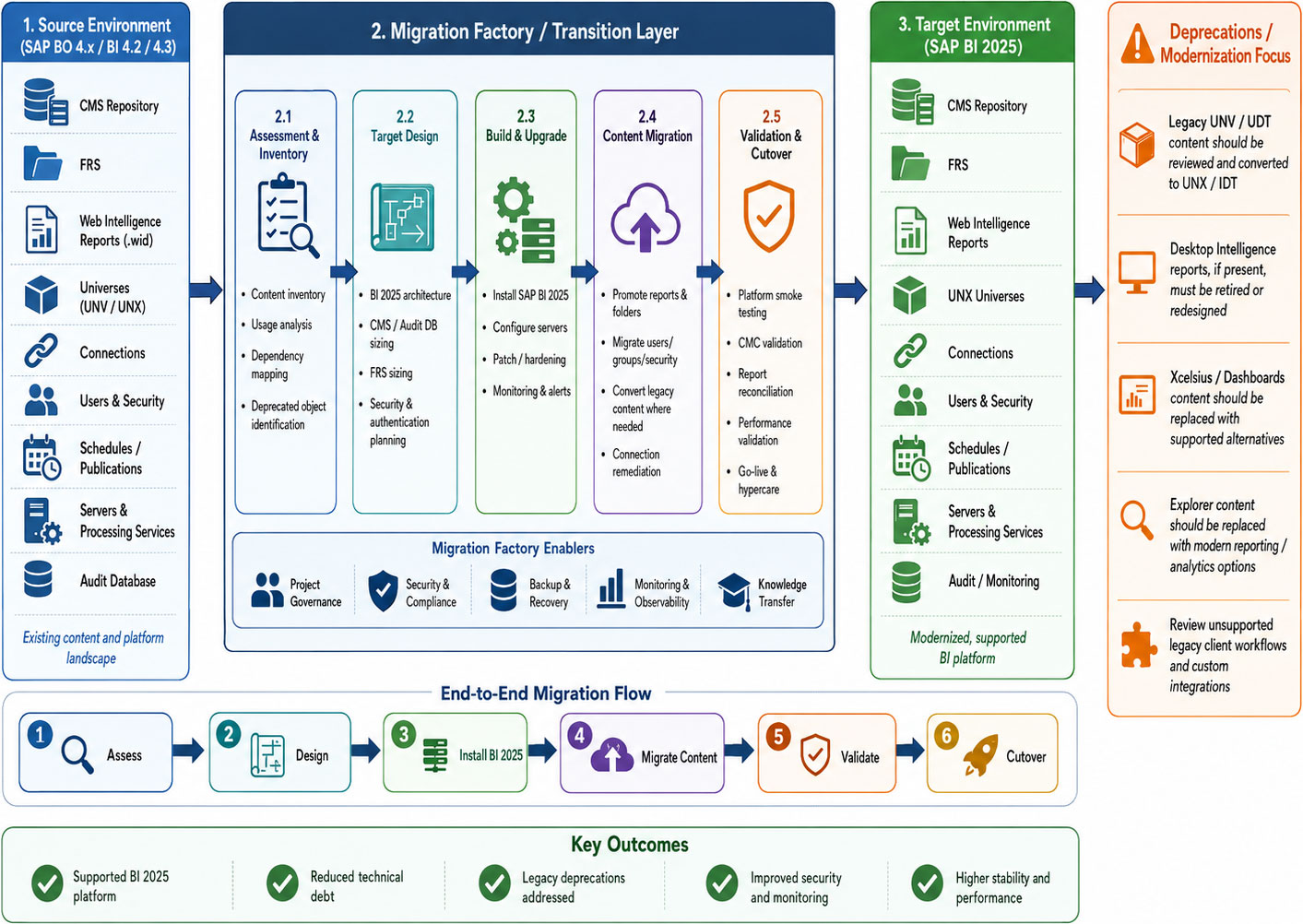
The project reality: this is an upgrade project, not a patch. BI 2025 drops UNV universes, multi-source universes, Analysis OLAP, Live Office, and Crystal Reports for Enterprise, and it needs a new license key. If your estate leans on any of those, there is remediation work to inventory and plan before go-live. Anyone who calls this “just an update” has not read the deprecation list.
-
Leave: move to Power BI or SAP Analytics Cloud
The right call when your organization has a Microsoft-first or cloud-first mandate, when BO usage has shrunk to a fraction of what you license, or when you are consolidating BI tools anyway and this deadline is the natural moment.
The project reality: leaving is a rebuild, not a copy job. No tool converts a universe into a semantic model: your universes get redesigned as data models and measures, Web Intelligence reports get recreated one by one, Crystal content becomes paginated reports, and your users get retrained. The semantic layer is where exit projects go sideways, because twenty years of business logic lives in it. Anyone who quotes an exit without counting your reports is quoting a demo, not your estate.
How to decide: the five questions we’ll ask you
- How much of your BO content is actually alive? Estates with thousands of reports often run on a few hundred. If usage has collapsed, the rebuild cost of leaving shrinks with it. If usage is broad and deep, staying gets a head start.
- What does your estate use that BI 2025 drops? UNV universes, multi-source universes, Live Office, Analysis OLAP, Crystal Reports for Enterprise. Zero hits means the upgrade is straightforward. Heavy hits mean remediation work either way, which changes the math.
- Where does your organization want analytics in five years? A board-level Microsoft-first or cloud consolidation mandate is expensive to fight. One platform decision rarely beats a strategy.
- Who runs the platform day to day? If your specialist left, stabilize first and decide second. A platform nobody operates makes every option look worse than it is.
- What does the license math say over the life of either path? Not this year’s renewal. Upgrade effort plus maintenance on one side; rebuild effort, new licenses, and retraining on the other. Migration quotes that skip the rebuild line are not quotes.
You could answer these yourself with a few weeks of internal workshops. Or bring them to the free Health Check below and we’ll work through them with you in 45 minutes.
Why you can trust the answer either way
No inflated case-study numbers here, because we won’t invent them. What you get instead is a practice that has run this platform for two decades and a promise in writing: we’ll tell you if staying is wrong for you. Our core business is keeping estates on BusinessObjects, which means every “migrate” or “you’re fine to wait” we put on paper is us talking ourselves out of work. That is exactly why it’s worth having.
The offer: a free BO 4.3 Health Check
45 minutes with people who deliver both paths. No fee, no prep documents required, no proposal unless you ask for one. You walk away with four deliverables:
- Deadline exposure summary: every BO component in your estate scored against December 31, 2026, so you see exactly what loses support and when.
- Deprecation inventory: which parts of your estate depend on what BI 2025 drops (UNV universes, multi-source universes, Live Office, Analysis OLAP, Crystal Reports for Enterprise), and what remediation each needs.
- Both-paths cost-driver comparison: stay (BI 2025 upgrade) and leave (Power BI or SAP Analytics Cloud) compared on effort, disruption, and license math for your estate.
- A stay-or-leave recommendation in writing. Even if the recommendation is “stay put and do the minimum.” You can put it in front of your board with our name on it.
Questions people ask before booking
Is BI 2025 just a patch on 4.3, or a real project?
A real project, and SAP’s own community says the same: it is a strategic upgrade, not an update. An in-place installation over 4.3 is a supported path, which helps, but you still need a new license key, a deprecation inventory, and proper testing. Teams that treat it as a patch are the ones posting install errors and asking peers for the runbook afterward.
What actually disappears in BI 2025?
UNV universes, multi-source universes, Analysis OLAP, Live Office, and Crystal Reports for Enterprise. If your estate uses none of those, the upgrade is far simpler. If it uses several, each needs a remediation plan: UNV to UNX conversion, workflow replacements for Live Office, and so on. That inventory is deliverable two of the Health Check, because it is the single biggest driver of upgrade effort.
What happens on January 1, 2027 if we do nothing?
Nothing switches off. Your platform keeps running and your reports keep scheduling. What ends is mainstream maintenance: through the end of 2027 you get security fixes only for high-severity vulnerabilities, and after that Customer-Specific Maintenance with no new fixes at all. For regulated industries, unsupported software under production reporting is an audit finding waiting for a date. The exposure summary shows which parts of your estate that bites first.
We’re still on 4.2. Is it too late for us?
No, but you are already living what 4.3 estates are worried about: 4.2 is out of support now. The good news is you get to skip a step. Rather than upgrading to 4.3 and then doing this again, most 4.2 estates should evaluate a direct move to BI 2025 or a platform exit in one decision. The same Health Check covers your situation; the exposure summary just starts from further behind.
Is BusinessObjects dying? Should we get off regardless?
No. SAP shipped BI 2025 in March 2025, has BI 2027 planned for early 2027, and has publicly committed to maintaining the BusinessObjects line until at least 2031. The urgency you are hearing is real for version 4.3 and manufactured for the platform. That distinction is worth a lot of money: it means staying is a genuine option, not a delay tactic, and any advisor who tells you otherwise is selling the exit.
Can we run old and new in parallel during the transition?
Yes, on both paths, and you should. On an upgrade, running BI 2025 alongside 4.3 lets you validate reports and universes before cutover. On an exit, running BusinessObjects alongside the new platform while reports are rebuilt and validated is the standard pattern; teams that have done it call the parallel run the thing that saved them. The catch is governance: set a dated plan for retiring the old side, or “transition” quietly becomes “two platforms forever.”
How long does the upgrade take, and what does it cost?
Honestly: it depends on your deprecation exposure, and anyone who gives you a number before inventorying your universes and content is guessing. An estate with clean UNX universes and no Live Office is a very different project from one with hundreds of UNV universes and OLAP workspaces. Even early adopters who planned carefully will tell you no upgrade is ever seamless. What we can give you in the Health Check is a defensible low and high range for your estate, assumptions stated, that you can budget against.
What does the Health Check cost, and what’s the catch?
Nothing, and the catch is transparent: a percentage of teams later ask us to deliver the path we recommended, and that is the business model. The deliverables, including the written stay-or-leave recommendation, are yours to keep either way. No proposal follows unless you request one, and if the right answer is “stay put and do the minimum,” that is what the recommendation will say.
Not ready to talk? Keep researching
Fair enough. This is a platform decision worth reading up on. Start with these, then come back when you want the questions answered for your estate specifically:
Data & intelligence work, delivered
Real engagements from the portfolio: same platforms, same problems.



141 days of runway. Two good paths. One honest answer.
45 minutes, free, and you leave with a stay-or-leave recommendation in writing. Even if it’s “stay put.”