


SAP BusinessObjects 4.3 after December 2026: your four options, honestly compared
Mainstream maintenance for BI 4.3 ends in four months. Below is the comparison we’d want if we were sitting on your side of the table: all four paths on one matrix, scored on cost, risk and deadline pressure, including the paths we don’t sell.
Book a free BO 4.3 Health CheckSee your four options ↓
Sound familiar?
“We’re on BI 4.2/4.3 and support is running out, and I still don’t have a plan I’d put my name on.”
“Reports break and nobody owns the fix. Tickets bounce between the BI team, the DBAs, and the vendor.”
“Our BO specialist left and took the knowledge with him. Nobody dares touch the universes now.”
“Licensing costs keep climbing and I have no visibility into what we’re actually using.”
“Leadership keeps asking whether to migrate or stay, and every vendor gives a different answer. Funny how each answer matches what that vendor sells.”
The dates that matter
- December 31, 2024
Mainstream maintenance for BI 4.2 ended. The same sequence 4.3 is now walking into, one version earlier. - March 12, 2025
SAP BI 2025 shipped: the on-premise continuation path for BusinessObjects estates. The platform is not ending; version 4.3 is. - Today
The last quarter in which a tested BI 2025 upgrade comfortably fits before the deadline. Below is the 90-day work that turns the decision into a scoped project. - December 31, 2026
Mainstream maintenance for BI 4.3 ends. Regular patches and fixes stop, and P1 support is withdrawn. - Q1 2027 (planned)
BI 2027, the next planned release on the on-prem path. SAP has committed to mainstream maintenance on this path until at least the end of 2031. - End of 2027
SAP’s one extra year of security-only fixes for 4.3 closes. That year covers high-severity vulnerabilities only, rated CVSS ≥ 7. After it: Customer-Specific Maintenance. You can keep running, but no new fixes of any kind.
Your four options, compared the way you’d compare them
If your reporting estate runs on BI 4.3, these are the four realistic paths. No option is missing because we don’t sell it.
| Compared on | Most estates land hereOption 1Upgrade to BI 2025The on-prem continuation path | Option 2Migrate to SAC or another platformReplatform the reporting estate | Option 3Third-party supportBuy runway, not a version | Option 4Ride CSMDo nothing and keep running |
|---|---|---|---|---|
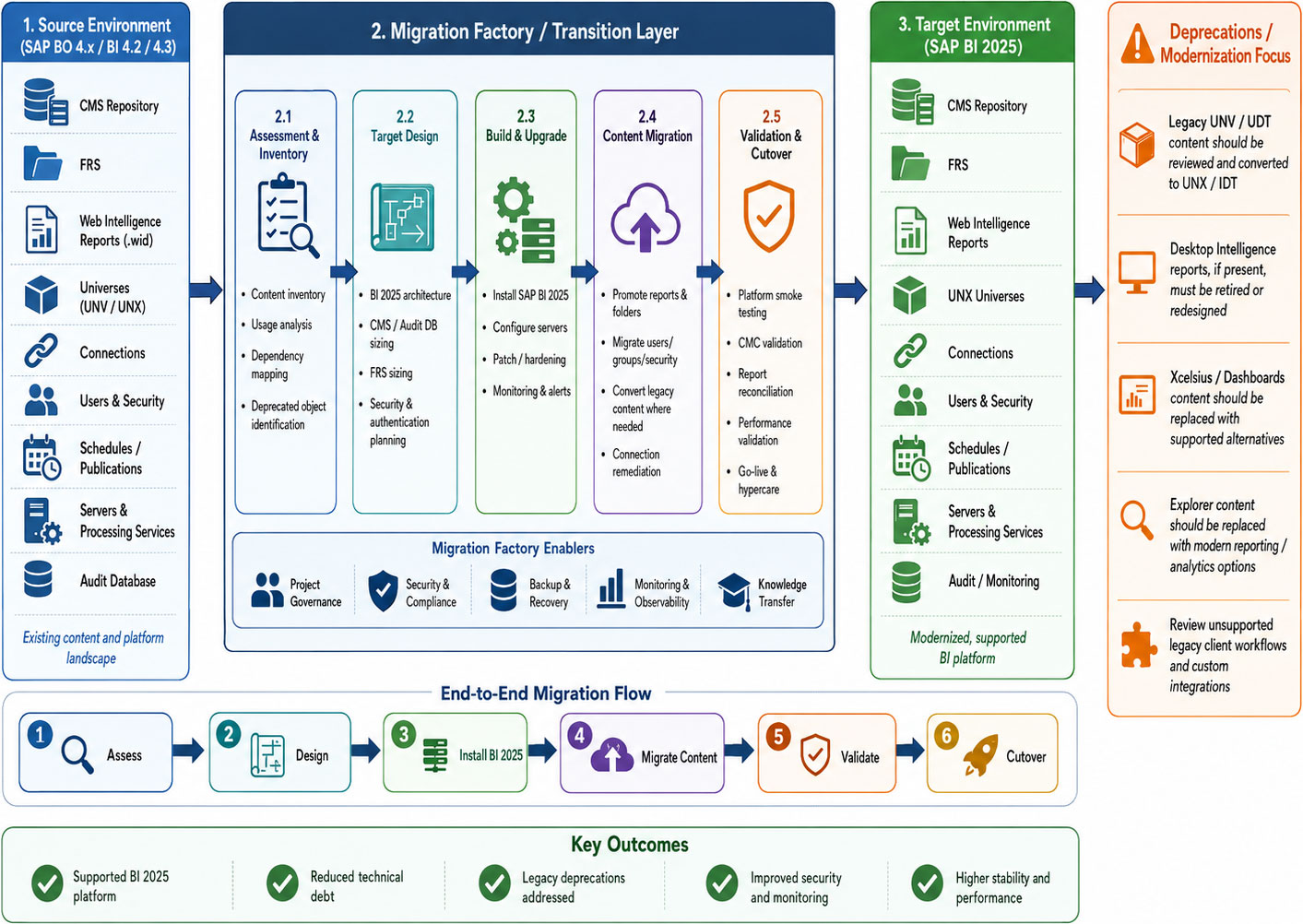
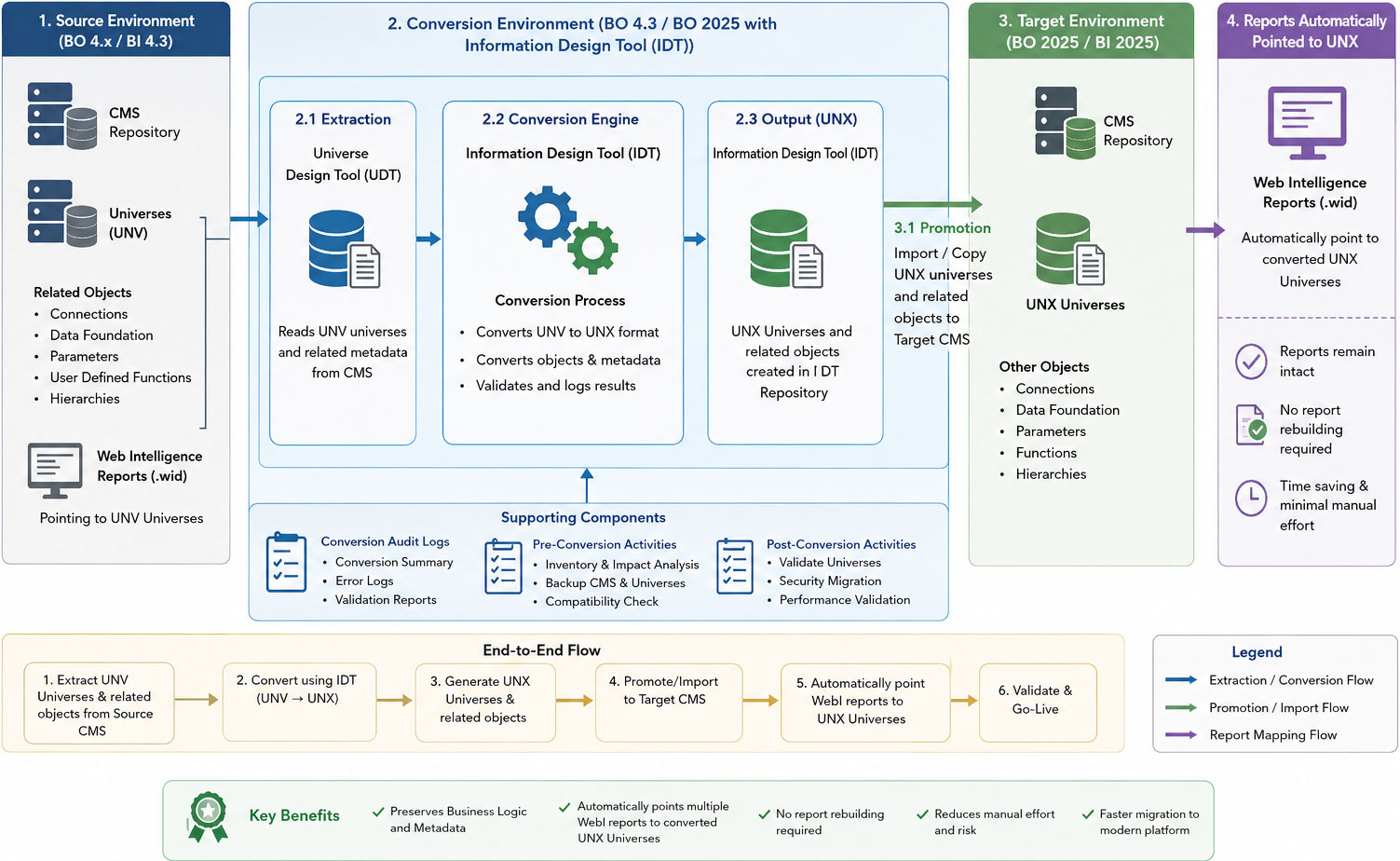
| What you are actually doing | A project, not a patch. Environment build, content migration, regression testing of reports, universes and schedules. No re-authoring: WebI, universes and security carry forward. | Every report re-authored or rationalized, semantic layers rebuilt, scheduling and bursting redesigned, users retrained, then a parallel run. | A contract switch. Break-fix and workarounds, but no SAP patches, no new versions, no compatibility updates for new browsers, OS or Java. | Nothing. You stay entitled to run 4.3 and stop receiving fixes of any kind. |
| Upfront cost driver | One upgrade project. Scales with estate size and test coverage, not with report count.Predictable enough to budget in a single cycle. | The largest of the four. Rebuild effort scales directly with report count.Rationalize first or pay to migrate junk. Most estates carry 40 to 70% dead reports. | Near zero. Contract negotiation and a support handover. | Zero today. It arrives later as compatibility decay and staff time on workarounds. |
| Ongoing cost | SAP maintenance continues roughly as today. | New subscription licensing plus legacy costs through a transition that is usually multi-year. | Typically 40 to 60% below vendor maintenance fees.Real savings, but you are buying time, not a future. | Maintenance fees typically continue, for a system receiving no new fixes. |
| Risk | LowSame product family, same skills, same content. The real risk is treating it as a casual patch instead of a tested upgrade. | Moderate to highGaps against mature scheduled and burst reporting have to be verified use case by use case, not assumed. | ModerateCheck your regulator’s and your cyber-insurer’s stance on non-vendor-supported software before you sign. | High and compoundingSecurity exposure once the CVSS ≥ 7 window closes at end of 2027. Unsupported reporting on regulated data is an audit finding in waiting. |
| Deadline pressure | Moderate3 to 6 months including testing. A late-2026 go-live has to start now. | High12 to 24+ months. Begun today, December 2026 is already out of reach, so you still need option 1 or 3 as a bridge. | LowAnd that is the trap. It removes the deadline without removing the problem. Fine as a bridge, corrosive as a destination. | Deceptively lowThe pressure arrives all at once, later, at the worst possible time. The forced move costs more than the planned one. |
| Who it suits | Estates that work, and users who depend on WebI and scheduled reporting. The large majority of 4.3 estates. | Organizations already committed to a cloud analytics strategy, with rationalized estates and use cases that fit self-service. | Organizations with a funded, dated exit plan that need 1 to 3 years of runway at lower cost, and whose compliance posture permits it. | Almost nobody as a strategy. Defensible only with a firm, funded decommission date that lands before the risk window matters. |
Scroll the matrix sideways to compare all four columns.
option 4 is rarely chosen. it’s what happens when nobody decides.
“You cannot expect to be able to move from BO to a free version of Power BI. You will need to use Power BI Premium, and the cost will likely be comparable to BO.” lbendlin, Super User, on the Microsoft Fabric Community thread Migration From SAP BO to Power BI
That is the part option 2 business cases usually get wrong. Leaving BusinessObjects is priced as a licence swap and delivered as a rebuild. The licence line often lands close to where it started once you size the target platform for the same user population and the same scheduled output.
The honest note most pages leave out
Most estates land on option 1 or 3. If your BO estate works and your users are served, the upgrade keeps two decades of reports, universes and skills alive at the lowest cost and risk. That’s not conservatism; it’s proportionality. If you have a funded, dated exit plan, third-party support is a legitimate bridge. Option 2 is right when your organization has already committed to a cloud strategy, usage has collapsed, or an ERP transformation is redesigning the analytics landscape anyway. Even then, most who choose it still bridge first, because 12–24 months doesn’t fit inside the runway to December 2026. Option 4 is almost never a decision; it’s what happens when nobody decides.

Your 90-day readiness checklist
Whatever option you lean toward, the same first steps apply. Ninety days of low-cost work converts a looming deadline into a scoped decision.
Days 1 to 30: know what you have
Inventory the estate from CMS and audit usage data, not folder counts. Flag anything untouched in 12 months for rationalization. Document versions, patch levels, platform dependencies, licence position and renewal dates.
Days 31 to 60: know what it costs
Get an upgrade estimate against your actual estate. If cloud is on the table, pilot-map your 10 most critical reports and see what survives contact. Price the do-nothing path honestly. Model licence right-sizing against real usage.
Days 61 to 90: decide and schedule
Put the matrix in front of the real decision-makers with numbers from your own estate. Pick a path. “Upgrade now, evaluate cloud in 2028” is a legitimate answer. Book the project window and assign an owner. Estates without a named owner ride into CSM by default, not by decision.
Why ask us: the SI that keeps you on BusinessObjects
Our practice is keeping BusinessObjects estates running well: upgrades, administration, universe work, 24×7 operations. That is where our revenue comes from. Which means when we tell you migration is your right answer, you can believe it, because we just talked ourselves out of an upgrade project. Read the matrix above with that in mind: option 2 is the one option we don’t profit from, and it still has a column.
The takeover promise
If your BO specialist left, or your current provider isn’t working out, we take over a live estate in 2–4 weeks, running in parallel with the incumbent, documenting as we go. No cutover cliff, no “knowledge transfer” that never happens, no gap in your report schedules.
Get your answer in 45 minutes: the free BO 4.3 Health Check
One structured session against your actual estate. You leave with the deliverables below whether or not we ever work together. No proposal unless you ask.
Version and support-risk map
Every BO component in your estate scored against the December 31, 2026 deadline, so you see exactly what is exposed and when.
Your row on the matrix, filled in
Which of the four columns your estate actually sits in, and our straight recommendation, including when staying put is the right call.
Licence cost watch-points
The specific line items and renewal traps to check before your next SAP conversation. Usage audits routinely surface five-figure annual savings.
A prioritized 90-day action list
The three to five moves to make this quarter, in order, whichever path you choose.
Frequently asked questions
What exactly happens on December 31, 2026?
Mainstream maintenance for BI 4.3 ends. Your system keeps running; nothing switches off. But SAP stops providing regular patches and fixes. For one additional year (through end of 2027), SAP provides security fixes only for high-severity vulnerabilities (CVSS ≥ 7). After that, you’re in Customer-Specific Maintenance: entitled to run the software, with no new fixes of any kind.
Is SAP killing BusinessObjects?
No, and this is the most common misreading of the deadline. SAP shipped BI 2025 on March 12, 2025 as the on-premise continuation of the platform, with BI 2027 planned for Q1 2027 and minor releases roughly every two years after that. SAP has committed to mainstream maintenance on that path until at least the end of 2031. The end-of-maintenance date applies to version 4.3, not to BusinessObjects as a product line. If your estate works, there is a supported path forward that doesn’t require replatforming.
How hard is the upgrade from 4.3 to BI 2025?
It’s a genuine project, not a patch. But it’s an upgrade, not a migration. Reports, universes, security and schedules carry forward. The real work is regression testing your critical reports and remediating anything touching deprecated features. Typical timeline: 3–6 months including testing, scaling with estate size. The riskiest version of this project is the one started in November 2026.
Can we just move everything to SAP Analytics Cloud instead?
You can. The question is whether you should, and whether you can in time. Full re-authoring of a mature BO estate takes 12–24+ months, so a migration decision made today still usually needs a supported bridge (upgrade or interim support) past December 2026. Cloud migration is right for organizations with a committed cloud strategy and rationalized estates; it’s an expensive detour when your core need is scheduled enterprise reporting that already works.
Is third-party support safe for a regulated company?
It’s legitimate, but do the diligence: you receive break-fix support and workarounds, not vendor patches or new versions. After SAP’s CVSS ≥ 7 window closes at the end of 2027, no one is issuing vendor security fixes for 4.3 at all. Confirm your regulator’s expectations and your cyber-insurance terms regarding non-vendor-supported software, and treat it strictly as a bridge with a dated exit, never as the destination.
We have 20 years of BO investment and skills. Does the deadline waste all that?
The opposite: that investment is the strongest argument for the upgrade path. On BI 2025, your reports, universes and your team’s expertise carry forward intact. The scenario that writes off two decades of investment is not the 4.3 deadline; it’s a reflexive replatform decision made under deadline pressure without a hard look at what the estate actually does for the business.
Our BO admin left. Can you take over support before we even decide on a path?
Yes. That’s often the first move. We take over live BO estates in 2–4 weeks, running in parallel with your incumbent or covering the gap directly, with 24×7 coverage from a 30+ consultant practice. A stable estate makes the 4.3 decision a choice instead of an emergency.
Data & intelligence work, delivered
Real engagements from the portfolio: same platforms, same problems.



December 31, 2026 is fixed. Your path isn’t, yet.
The organizations that decide now get to choose their path. The ones that decide in Q4 get chosen for. 45 minutes, free, no pitch, and you keep the findings either way.