


Intelligent Automation for Export Documentation, Customs Compliance & Customer Service Operations
Overview
A global shipping and logistics provider handling thousands of international export shipments daily engaged TechTiera to assess where intelligent automation could relieve pressure on its core operations — Bill of Lading (B/L) issuance, customs filing, arrival notifications, and customer communications. These processes were highly repetitive, time-sensitive, and governed by strict regulatory and service-level requirements, making them prime candidates for automation.
TechTiera engineers conducted a full process assessment and identified multiple opportunities to streamline export documentation and customer service operations through RPA. The engagement focused on designing an automation framework spanning document generation, customs data submission, customer communications, exception management, and operational reporting — demonstrating how RPA could reduce manual effort, improve compliance, and accelerate end-to-end shipping operations.
Note: this engagement centered on process assessment and solution design; the figures below reflect the projected impact of the proposed automation framework, based on outcomes typical of comparable implementations.
The Challenge
The logistics operations team was running a set of high-volume, high-stakes processes almost entirely by hand. Specifically:
- Manual preparation and issuance of Bills of Lading (B/L) increased processing time and the risk of human error
- Customer requests arriving through email and EDI channels required continuous manual monitoring and handling
- Arrival notices had to be generated and distributed promptly based on vessel Estimated Time of Arrival (ETA)
- Customs documentation for U.S. and Canadian shipments required accurate, timely submission to avoid shipment delays
- Customer service teams were handling large volumes of repetitive inquiries through email and chat
- Exception handling and operational escalations were tracked and consolidated manually
- Supervisory reporting required manually compiling data from multiple operational systems
Every one of these processes carried real downstream consequences — a late Bill of Lading or a missed customs submission doesn’t just create rework, it can hold up an actual shipment.
Solution
Solution Architecture
TechTiera engineers designed an intelligent automation framework to streamline export documentation and customer service operations by integrating shipping systems, EDI transactions, customs workflows, and customer communication channels:
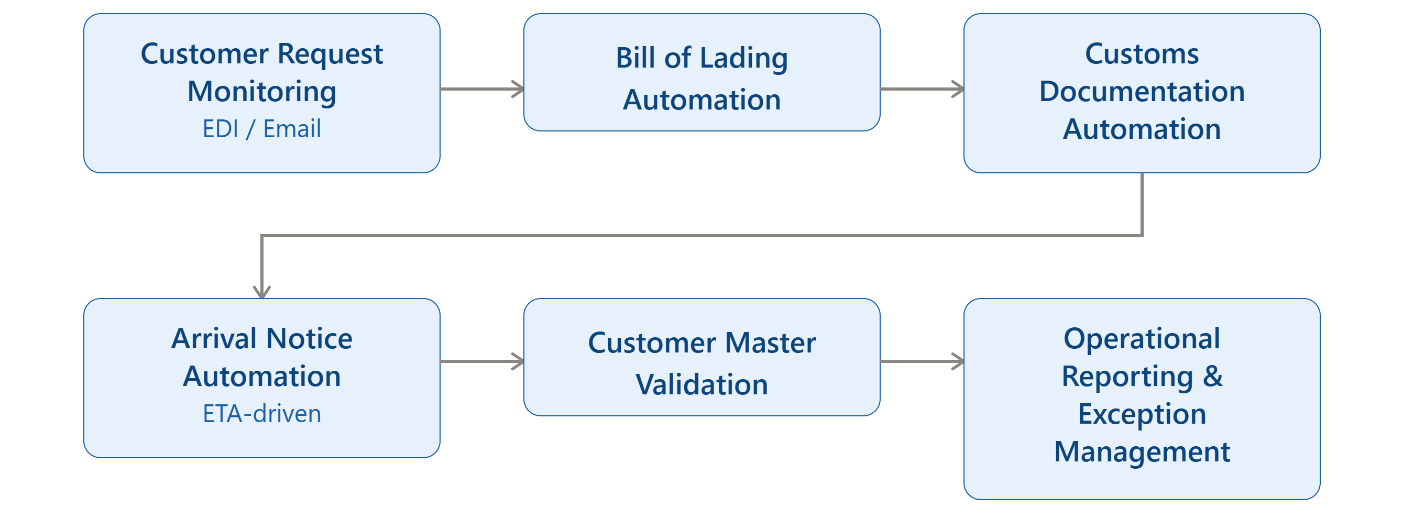
The design treated customer communication, document generation, and customs submission as parts of one connected workflow rather than separate systems that happened to touch the same shipment.
Solution Components
Automated Bill of Lading (B/L) Processing
The proposed solution automates the end-to-end generation of Bills of Lading — monitoring customer requests received via EDI and email, validating shipment details, generating standardized Bills of Lading, updating shipping systems, and routing documents for electronic delivery.
Intelligent Customer Request Management
Automation continuously monitors customer communication channels, categorizes incoming requests, retrieves shipment information, generates responses for routine inquiries, and routes anything more complex to customer service representatives — so reps spend their time on the exceptions that actually need a human, not the routine ones that don’t.
Arrival Notice Automation
The platform integrates with vessel schedules to monitor Estimated Time of Arrival (ETA), automatically generate arrival notices, notify customers via email or EDI, and eliminate a good deal of manual tracking activity that previously fell on operations staff.
Customs Documentation Automation
The solution automates customs-related activities — preparing customs documentation, validating shipment data, submitting Bill of Lading information electronically through EDI, tracking customs acknowledgments, and flagging exceptions that require manual review rather than letting them slip through.
Customer Master Validation
Automation supports customer master data validation by checking customer codes (CSOP), verifying master data accuracy, flagging missing or inconsistent information, and reducing the processing errors that stem from bad reference data further downstream.
Operational Reporting & Exception Management
The framework generates daily operational reports, exception reports, escalation summaries, supervisor dashboards, and SLA monitoring reports — replacing manual report compilation with something operations leadership can actually rely on in real time.
4. TechTiera Responsibilities
TechTiera’s responsibilities on this engagement included:
- Business process analysis
- Current-state process assessment
- Automation opportunity identification
- Solution architecture
- Workflow design
- Customer interaction analysis
- Documentation standardization
- Exception handling design
- Reporting framework design
- Deployment planning
- Managed services recommendations
5. Technology Stack (Proposed)
RPA Platform: | Tungsten RPA (Formerly Kofax Kapow or Kofax RPA) |
OCR / Workflow / IDP: | Tungsten TotalAgility (Formerly Kofax Total Agility (KTA)) |
Integration: | EDI, Email, Shipping Systems |
Data Sources: | Shipping Management Systems, Customs Systems |
Document Automation: | Bill of Lading Generation |
Notifications: | Email, EDI |
Reporting: | SQL Server, Power BI |
Managed Services: | Production Monitoring & Support |
6. Results and Business Impact
Projected Outcomes
| Area | Before | After |
|---|---|---|
Bill of Lading issuance | Manual preparation per shipment | Automated generation and distribution |
Customer request handling | Manual monitoring of email/EDI | Automated categorization and response for routine inquiries |
Arrival notices | Manually tracked against ETA | Automatically generated and distributed on ETA trigger |
Customs submissions | Manual preparation and filing | Automated EDI submission with acknowledgment tracking |
Operational reporting | Manual compilation across systems | Automated dashboards and SLA monitoring |
Business Benefits
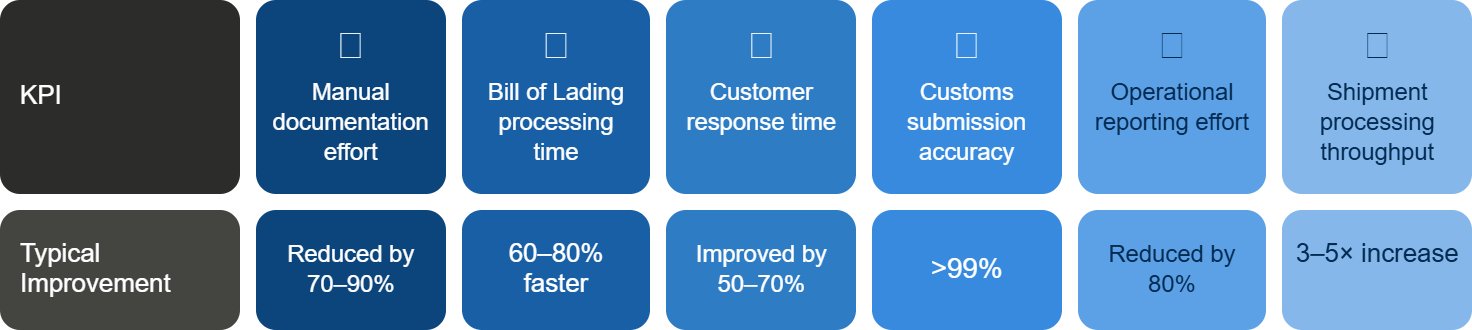
Benefits achieved by TechTiera’s automation implementation:
7. ROI
Major outcomes for engagement include:
- Return on investment within 6–9 months
- Significant reduction in manual documentation costs
- Improved customer satisfaction through faster response times
- Reduced customs delays from more accurate and timely submissions
- Increased operational capacity without proportional increases in staffing
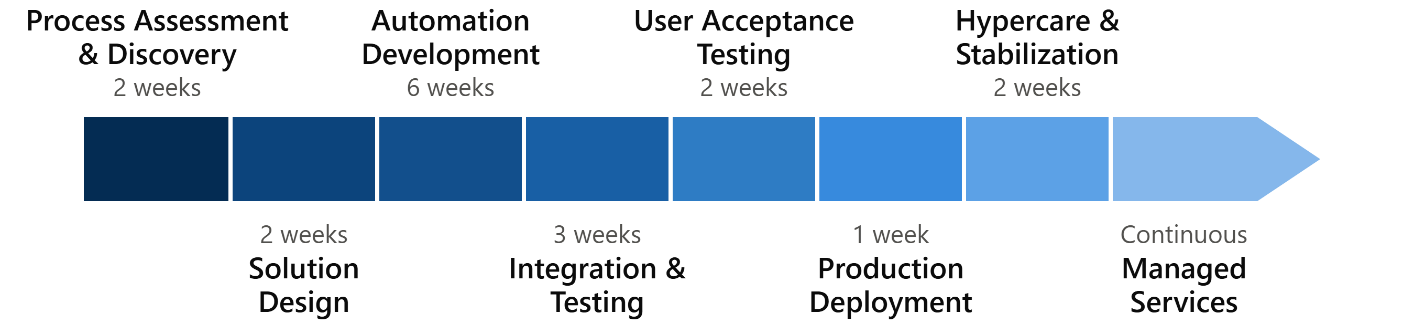
8. Project Execution Timeline
9. Project Hurdles and Lessons Learned
Key Challenges Identified
Shipping documentation processes touch multiple stakeholders, communication channels, and regulatory regimes at once, which meant any automation design had to account for that complexity rather than treat B/L issuance as an isolated task. Customs clearance workflows demand accurate, timely electronic submissions — there’s little room for error before a shipment delay becomes real. Customers reach out through EDI, email, and chat in no consistent pattern, so the automation needed to handle multiple channels flexibly rather than assume one format. Operational reporting depends on pulling consistent data out of multiple systems, which required a standardized consolidation approach. And maintaining service levels during peak shipping periods meant the automation had to be built for scale from the outset, not added on after volumes grew.
Lessons Learned
Standardizing documentation processes ahead of automation makes a measurable difference in how smoothly the automation itself performs — trying to automate around inconsistent formats just pushes the inconsistency downstream. Integrating customer communication channels directly with workflow automation meaningfully improves responsiveness and service quality rather than treating communication and processing as separate systems. Automated customs validation reduces both compliance risk and processing delays, since problems get caught before submission rather than after a shipment is already held up. Centralized exception handling gives operations leadership real visibility instead of relying on scattered manual tracking. And in high-volume logistics operations specifically, continuous monitoring and optimization aren’t optional extras — they’re what keeps performance steady once volumes hit peak season.
10. Best Practices Implemented (Proposed Design)
- Standardized export documentation workflows
- Automated validation prior to Bill of Lading generation
- Integration of EDI transactions with workflow automation
- Automated ETA monitoring and customer notifications
- Centralized exception tracking and escalation management
- Structured operational reporting and dashboarding
- Comprehensive audit logging for document generation and customs submissions
- Modular workflow design to support future enhancements
- Continuous monitoring and proactive operational support
11. Security & Compliance
The proposed solution was designed to support enterprise logistics governance and regulatory compliance, including:
- Secure processing of shipment and customer information
- Role-based access controls for shipping operations
- Comprehensive audit trails for document generation and customs submissions
- Secure EDI communications with customs authorities and customers
- Controlled change management for workflow updates
- Compliance with shipping documentation standards and applicable customs regulations for U.S. and Canadian destinations
- Alignment with enterprise operational governance and information security practices
12. Business Value Delivered
TechTiera demonstrated how intelligent automation can transform export documentation and customer service operations within the logistics industry. By designing automation for Bill of Lading generation, customs documentation, arrival notifications, customer communications, and operational reporting, the proposed solution offers a path to reduced manual effort, improved compliance, and stronger customer responsiveness. The automation framework provides a scalable foundation for modern logistics operations — giving shipping organizations a route to greater throughput, better service quality, and sustained regulatory compliance as international trade volumes continue to grow.