


Intelligent Automation for Electronic Components BOM Documentation
Overview
A global engineering information and supply chain data provider came to TechTiera with a documentation bottleneck that had simply outgrown its process. The company maintains a massive catalog of electronic component data sourced from hundreds of manufacturers, and every one of those components needs a standardized Bill of Materials document — technical specs, formatted properly, published for engineering and procurement teams to use downstream.
TechTiera engineers were brought into design and build an end-to-end intelligent automation solution that could take this process — extraction, validation, formatting, publishing — and run it as one continuous automated pipeline instead of a chain of disconnected manual steps.
The Challenge
The trouble was where the source data actually lived: scattered across hundreds of manufacturer websites, each built differently, each organizing its datasheets and spec pages in its own way. Engineers on the client side were manually hunting down part information, copying it over, reconciling naming and unit differences between manufacturers, and then hand-formatting everything into Word documents.
It worked, in the sense that documents got produced, but it didn’t scale, it wasn’t consistent, and every time a manufacturer updated a datasheet somewhere, someone had to notice and redo the work. Specifically, the client was dealing with:
- Technical specifications dispersed across hundreds of manufacturer sites, each with a unique layout and data structure
- Engineers spending significant time manually collecting BOM data from multiple sources
- Heavy manual editing just to standardize documentation across manufacturers
- Repetitive, time-consuming Word formatting for every technical document produced
- Inconsistencies and formatting errors creeping in from manual preparation
- A growing component catalog that manual processing simply couldn’t keep pace with
- Constant manufacturer-side updates requiring ongoing monitoring and document revisions
- A need for a repeatable process that could handle millions of component records without sacrificing quality
By the time TechTiera got involved, the volume had grown to the point where throwing more people at the problem wasn’t really an option anymore.
Solution
Solution Architecture
TechTiera engineers designed a fully automated document generation platform on Tungsten Automation (formerly Kofax Kapow), combining intelligent web data extraction, structured data validation, database integration, and automated Microsoft Word document generation into a single pipeline. The architecture breaks down into four stages that hand off to each other:
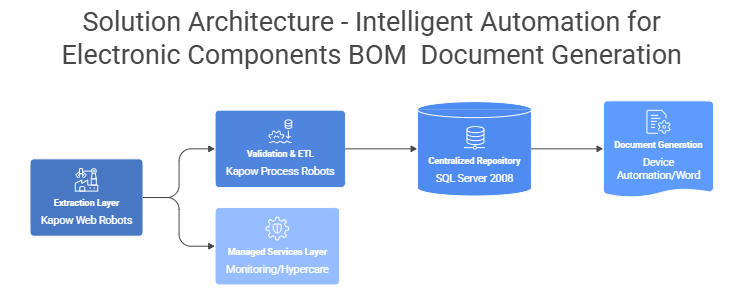
Each stage runs independently of the others, which turned out to matter a great deal for reliability and scaling later on — a failure or slowdown on one side of the pipeline never became a problem on the other.
Solution Components
Intelligent Data Crawlers
Rather than writing a one-off scraper for every manufacturer — which would’ve been unmaintainable given how many sites were involved — TechTiera engineers built a reusable crawler framework organized around site patterns rather than individual manufacturers. Each pattern got a configurable robot template, parameterized for that site’s URL structure, pagination, and DOM layout. Kapow’s extraction model works off the actual DOM rather than screen coordinates, so robots could use XPath selectors with fallback chains, giving the system tolerance for the inevitable minor layout tweaks manufacturers make over time. Change-detection logic compared newly extracted values against what already sat in the repository, so the system only flagged components that actually needed reprocessing instead of re-crawling the entire catalog on every run.
Data Validation & Processing
Raw scraped data from hundreds of sources is never usable as-is. TechTiera engineers built a normalization layer that handles cleansing (stripping encoding artifacts and formatting junk), mapping each manufacturer’s field names and units into the client’s canonical schema, catching duplicates by part number plus a normalized attribute fingerprint, and extensive regex-based parsing for pulling structured values — tolerances, package codes, compliance markings — out of free-text fields with no clean DOM element to extract from directly.
Centralized BOM Repository
Validated records land in a Microsoft SQL Server 2008 repository, matched to the client’s existing enterprise environment. Beyond just storage, the repository is the seam in the architecture — the thing that keeps extraction and document generation from being directly coupled. Extraction robots never touch Word, and the document-generation robots never touch the web.
Automated Technical Documentation
This was the most technically interesting piece of the build. The deliverable had to be a properly formatted Word document, and there was no clean API path to reproduce the client’s exact template formatting programmatically. So TechTiera engineers used Kapow’s Device Automation capability to directly drive Microsoft Word — launching the application, selecting the right template for the component category, populating fields and BOM tables, applying heading styles and spacing rules, and saving the finished file, with no human touching any of it.
Getting this reliable took real engineering effort. UI automation is timing-sensitive by nature — fixed delays between steps eventually collide with Word still mid-render or mid-save, producing a corrupted or incomplete document. TechTiera engineers built explicit state checks — confirming a save had actually completed, confirming a dialog had actually closed — before letting the robot proceed, rather than relying on a guessed sleep interval.
Deployment & Managed Services
Following go-live, TechTiera continued to provide production monitoring, bot health checks, change management, enhancement support, incident response, ongoing maintenance for manufacturer website changes, and performance optimization.
4. TechTiera Responsibilities
TechTiera delivered the engagement end-to-end, owning:
- Solution architecture & technical design
- RPA development across the full pipeline
- Customer workshops and business requirement analysis
- Device automation development
- Web crawling development
- SQL database integration
- Production deployment
- User acceptance support
- Hypercare support
- Managed services and continuous improvement
5. Technology Stack
Technology Stack
| Category | Detail |
|---|---|
| RPA Platform | Tungsten RPA (Kofax Kapow) 9.7.3 / 9.7.4 / 10.3 |
| Dev. Environment | Kapow Design Studio |
| Device Automation | Microsoft Word Automation |
| Database | Microsoft SQL Server 2008 |
| Data Processing | Regular Expressions |
| Data Collection | Intelligent Web Crawlers |
| Operating Environment | Windows |
| Doc Generation | Microsoft Word |
| Managed Services | Production Bot Support & Monitoring |
Results and Business Impact
Measurable outcomes
| Area | Before | After |
|---|---|---|
| Data acquisition | Manual browsing, site by site | Fully automated across hundreds of manufacturer sites |
| Document formatting | Manual, inconsistent | Automated, template-standardized, no manual touch |
| Scaling | Limited by headcount | Limited only by bot capacity |
| Change response | Manual monitoring for updates | Automated detection and reprocessing |
| Errors | Inconsistencies from manual editing | Rule-based automation with standardized templates |
Business Benefits
Benefits achieved by TechTiera’s automation implementation

7. ROI
Major outcomes for engagement include:
- Payback period of 6–12 months
- Significant reduction in labor costs tied to document creation and maintenance
- Increased engineering productivity, freeing subject matter experts to focus on higher-value work instead of manual documentation
- Lower operational costs through reduced manual intervention
- Faster availability of technical documentation, improving customer responsiveness and time-to-market
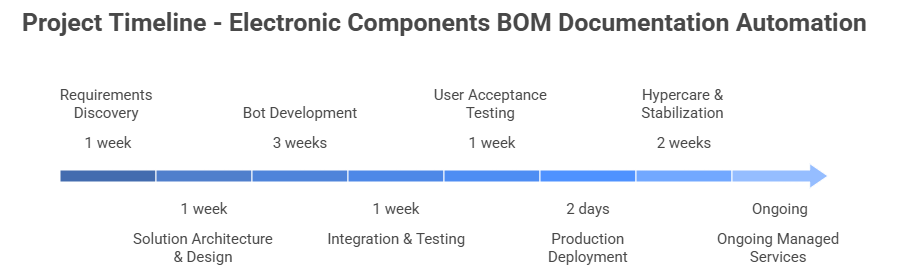
8. Project Execution Timeline
9. Project Hurdles and Lessons Learned
Key Challenges
Manufacturer sites drift constantly — layout changes required the crawling logic to be genuinely adaptable rather than hardcoded against a fixed structure. Handling hundreds of distinct HTML structures demanded reusable extraction components from day one, or maintenance would have become unmanageable. Word desktop automation needed careful synchronization to produce reliably formatted output every time. Incomplete or inconsistent source data had to be caught and managed before it ever reached document generation. And balancing extraction speed against accuracy at this scale required continuous tuning rather than a one-time configuration.
Lessons Learned
Modular crawler design significantly simplifies maintenance when source websites change — a monolithic scraper doesn’t survive contact with hundreds of independently-changing sites. Reusable automation components reduce development time and improve long-term maintainability. Centralized validation before document generation improves overall data quality far more than validating after the fact. Device Automation remains highly effective for legacy desktop applications when no API is available — it just requires proper synchronization rather than fixed delays. And continuous monitoring and proactive maintenance are essential for any long-running enterprise RPA solution; this isn’t a “deploy and walk away” kind of system.
10. Best Practices Implemented
- Modular, reusable bot architecture
- Exception handling with automated retry mechanisms
- Standardized document templates for consistent output
- Centralized logging and monitoring across the automation pipeline
- Parameter-driven configuration to simplify long-term maintenance
- Database-backed audit trails for traceability
- Automated validation gates before document generation
- Production monitoring with proactive support and maintenance
- Structured change management to accommodate evolving source systems
11. Security & Compliance
The solution was built with enterprise governance and operational control in mind:
- Role-based access to automation environments
- Secure handling of technical and proprietary product information
- Controlled database access and credential management, kept outside of core robot logic
- Comprehensive logging and audit trails across all automation activity
- Version-controlled automation workflows and deployment artifacts
- Structured change management procedures for updates to bots and source integrations
- Adherence to enterprise security, quality, and operational standards throughout development and production support
12. Business Value Delivered
By implementing an end-to-end intelligent automation solution, TechTiera transformed a labor-intensive documentation process into a scalable, standardized, and highly efficient operation. The engagement demonstrated TechTiera’s ability to deliver enterprise-grade RPA solutions spanning solution architecture, development, deployment, and long-term managed services. The result was technical documentation produced faster, with greater accuracy and consistency, while giving the client room to keep growing its electronic component data volumes without a matching increase in operational effort.