


Intelligent Sourcing Data Automation and Critical Market Intelligence Platform

Overview
A global provider of engineering, manufacturing, and industrial market intelligence needed to pull together sourcing and product intelligence from multiple external data providers into something business users could actually rely on. Strategic procurement, supply chain planning, competitive intelligence, and market analysis teams all depended on this data — but getting it meant manually visiting external websites and repositories on a set schedule, downloading files, extracting data, validating records, and integrating everything into internal databases by hand.
TechTiera engineers designed and built a scalable intelligent automation solution that continuously collects sourcing intelligence from multiple external sources, integrates it into centralized repositories, and automates the entire data acquisition lifecycle end to end — cutting manual effort while improving how timely, consistent, and trustworthy the resulting intelligence actually is.
The Challenge
The client’s problem was less about any single difficult data source and more about the operational overhead of coordinating many of them manually. Specifically:
- Business-critical market information was scattered across numerous external data sources and supplier websites
- Manual collection was repetitive, labor-intensive, and prone to inconsistency between runs
- Information needed to be gathered on a regular cadence to support timely business decisions
- Different sources came in different formats and structures, requiring different extraction techniques for each
- Delays in information gathering directly impacted downstream analytics and procurement decisions
- Manual downloading, validation & integration had become an operational bottleneck in its own right
- Growing volumes of market intelligence needed a solution that could scale, not one that scaled headcount alongside it
Solution
Solution Architecture
TechTiera engineers designed a robust intelligent data acquisition and integration platform combining Tungsten RPA (formerly Kofax Kapow), custom Java processing components, VBA automation utilities, and Microsoft SQL Server — automating the complete lifecycle from extraction and file download through validation, transformation, and storage:
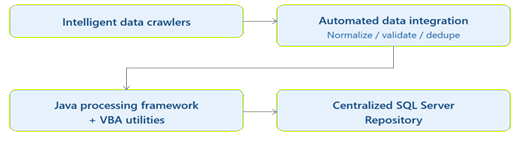
The mix of technologies here wasn’t incidental — RPA handled the web-facing extraction, Java handled heavier business-rule and transformation logic, and VBA covered supplementary processing tasks that didn’t need a full application built around them. Getting these three to work together reliably was one of the more interesting engineering problems in the build.
Solution Components
Intelligent Data Crawlers
TechTiera engineers built enterprise-grade robots to monitor multiple external information sources, collect sourcing intelligence, capture supplier information, extract product and component data, download both structured and unstructured files, and continuously watch for updates — without anyone manually revisiting these sources on a schedule.
Automated Data Integration
Once data came in from multiple external sources, the platform automatically normalized it, validated records, removed duplicates, transformed everything into standardized formats, and loaded the result into centralized repositories. This is the layer that turned “a pile of files from different sources” into something business users could actually query and trust.
Java-Based Processing Framework
TechTiera engineers built custom Java components to handle business rule processing, data transformation, logic, file processing, high-volume data handling, and performance optimization — the kind of heavier-weight logic that made more sense as dedicated services than as RPA workflow steps.
VBA Utility Automation
Supporting VBA tools handled supplementary processing activities — file preparation, data formatting, validation support, report generation, and general productivity tooling — rounding out the automation stack for tasks that didn’t warrant a full Java service or RPA robot of their own.
Centralized Enterprise Repository
Validated information landed in Microsoft SQL Server, supporting historical tracking, enterprise reporting, data consistency, business analytics, and market intelligence dashboards.
Deployment & Managed Services
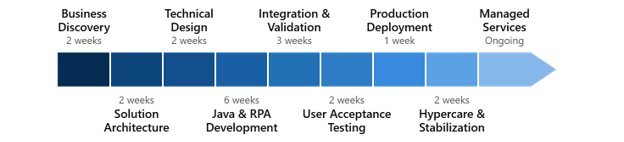
Following implementation, TechTiera continued providing production monitoring, robot maintenance, enhancement development, performance optimization, incident management, continuous improvements, and ongoing managed services.
4. TechTiera Responsibilities
TechTiera delivered the complete engagement, including:
- Business requirements analysis
- Solution architecture and technical design
- Customer workshops
- Java application development
- VBA tool development
- Tungsten RPA robot development
- Integration development
- Testing and validation
- Production deployment
- User acceptance support
- Hypercare
- Production monitoring
- Managed services and continuous improvement
5. Technology Stack
RPA Platform: | Tungsten RPA (Kofax Kapow) 9.7.3 / 9.7.4 / 10.2 |
Programming: | Java |
Automation Utilities: | VBA |
Database: | Microsoft SQL Server 2008 |
Web Technologies: | HTML5 |
Data Acquisition: | Intelligent Web Crawlers |
Data Integration: | Automated ETL & Validation |
Operating Environment: | Windows |
Managed Services: | Production Monitoring & Support |
6. Results and Business Impact
Measurable outcomes
| Area | Before | After |
|---|---|---|
Source monitoring | Manual, scheduled visits | Fully automated collection across sources |
Data integration | Manual normalization/dedup | Automated ETL with validation built in |
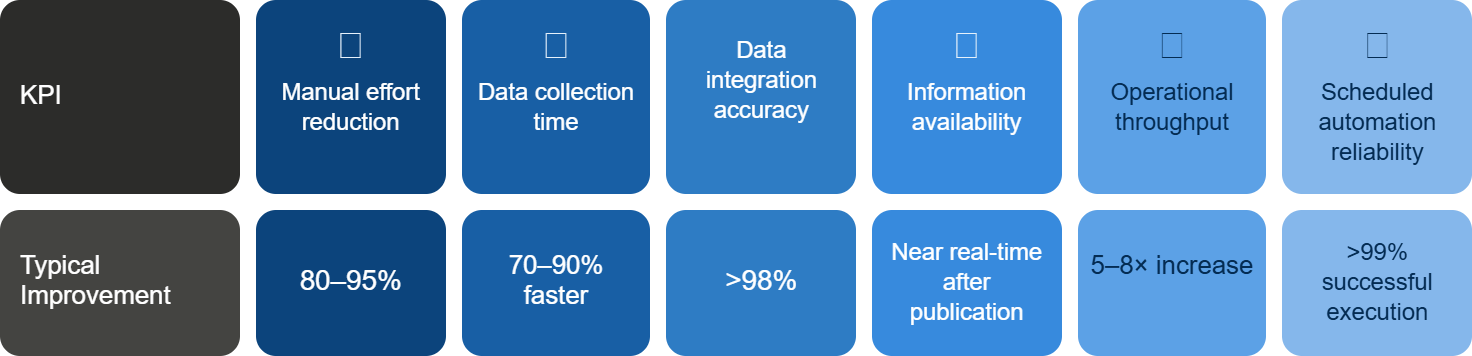
Data availability | Delayed by manual processing | Near real-time after publication |
Reliability | Dependent on manual consistency | Scheduled execution with >99% reliability |
Scalability | Constrained by manual capacity | Scales with growing information volumes |
Business Benefits
Benefits achieved by TechTiera’s automation implementation:
7. ROI
Major outcomes for engagement include:
- Return on investment within 6–12 months
- Significant reduction in operational costs tied to manual data collection
- Increased analyst productivity through automated information gathering
- Faster business decision-making from timely access to validated market intelligence
- Improved scalability without increasing operational headcount
8. Project Execution Timeline
9. Project Hurdles and Lessons Learned
Key Challenges
Integrating information from multiple external sources with genuinely different data structures required an architecture flexible enough to onboard each one without a full redesign. Maintaining data quality across large volumes of sourced information demanded validation and transformation logic robust enough to catch problems before they reached the repository, not after. Coordinating Java applications, VBA utilities, and RPA workflows together required careful orchestration — three different technology layers all needed to hand off cleanly for the end-to-end process to actually work. Scaling the platform to handle increasing data volumes while holding performance steady took continuous optimization rather than a one-time tuning pass. And source systems kept changing on their own timelines, which meant ongoing maintenance and proactive monitoring were baked into the operating model from day one.
Lessons Learned
Combining RPA with custom Java components turned out to be a genuinely powerful pattern for complex enterprise data integration — each technology did the part it was actually good at, rather than forcing everything through a single tool. Modular crawler and integration design significantly reduced maintenance effort and made onboarding new data sources faster over time. Centralized scheduling and monitoring improved both operational reliability and the team’s visibility into what was actually happening in production. Automated validation before repository updates made a measurable difference in overall data quality compared to validating after the fact. And, consistent with other engagements of this kind, continuous managed services proved essential for keeping a platform like this healthy over the long run — the sources it depends on don’t stand still, so the automation can’t either.
10. Best Practices Implemented
- Modular and reusable automation architecture
- Integration of RPA, Java, and VBA for end-to-end process automation
- Centralized scheduling and production monitoring
- Automated validation, normalization, and duplicate handling
- Exception handling with configurable retry mechanisms
- Comprehensive logging and audit trails
- Performance optimization for high-volume data processing
- Structured release and change management
- Continuous monitoring and proactive production support
11. Security & Compliance
The solution was designed in alignment with enterprise governance and operational security standards, including:
- Secure access to automation infrastructure and enterprise databases
- Role-based access controls for production environments
- Comprehensive audit logging for data extraction, transformation, and loading activities
- Version-controlled development and deployment of automation assets
- Controlled production releases through established change management processes
- Secure storage and management of business-critical sourcing intelligence
- Compliance with enterprise information security, operational governance, and quality management standards
12. Business Value Delivered
TechTiera delivered a comprehensive intelligent automation platform that transformed the client’s sourcing intelligence operations. By automating the acquisition, validation, integration, and storage of critical market information from multiple external sources, the solution significantly reduced manual effort, accelerated information availability, and improved data quality for strategic decision-making. Through its combination of Tungsten RPA, Java-based integration services, VBA utilities, and ongoing managed services, TechTiera established a scalable, resilient, enterprise-ready solution that continues to support high-volume market intelligence operations while enabling faster and more informed business decisions.