


Intelligent Web Crawling and Automated Regulatory Data Collection for U.S. Oil & Gas Well Information

Overview
A global provider of energy market intelligence and commodity information needed to keep its proprietary energy platforms fed with timely, accurate regulatory data — well permits, drilling reports, production data, geological records, and supporting documents — published across dozens of U.S. federal and state government agencies. Customers across exploration, production, investment, and energy analytics all depended on that data being current.
The problem was that the existing process relied on people manually checking government websites and FTP repositories for newly published or revised documents across a range of formats. It was labor-intensive, prone to missed updates, and simply couldn’t scale as the number of source agencies kept growing. TechTiera engineers designed and built a highly scalable intelligent web crawling platform on Tungsten Automation (formerly Kofax Kapow) to take over the entire monitoring, detection, and ingestion process — and to do it incrementally, rather than reprocessing everything on every run.
The Challenge
Customer was managing a regulatory data landscape that was both large and structurally messy. Specifically:
- Dozens of federal and state government websites and FTP repositories required daily monitoring for updates
- Well information was published in a wide mix of formats — PDF, TIFF, ZIP, XML, and other structured files
- Manually identifying newly published or revised documents consumed significant operational effort
- Duplicate downloads were inflating both processing time and storage requirements
- Government portals varied wildly in authentication methods, navigation patterns, and underlying technology
- Downstream energy information systems needed new data quickly — delays had real business impact
- Frequent website changes meant extraction logic needed continuous maintenance just to keep working
- The scale of the problem demanded an architecture that was resilient and automated by design, not manual with automation bolted on
By the time TechTiera got involved, the client’s ability to grow its data source coverage was directly constrained by how much manual monitoring capacity it had.
Solution
Solution Architecture
TechTiera engineers designed a robust enterprise automation framework on Tungsten Automation (Kofax Kapow), combining intelligent web crawling, incremental file detection, enterprise integration, multi-format document processing, and centralized scheduling:
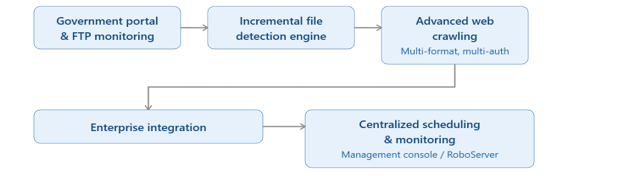
Given the number of source agencies and the variety of technologies involved, the architecture had to treat “new source onboarding” and “ongoing maintenance” as first-class concerns from day one, not afterthoughts.
Solution Components
Intelligent Government Portal Monitoring
TechTiera engineers built robots capable of monitoring federal government websites, state regulatory agency portals, FTP repositories, HTTP-based sites, and secure web applications — continuously watching all of them for new or modified regulatory publications, rather than relying on scheduled manual spot-checks.
Incremental File Download Engine
This was arguably the most valuable piece of engineering in the whole solution. Instead of pulling down every available document on every run, the automation compares against previously processed files, identifies genuinely new documents, detects revised versions of existing ones, and downloads only what’s actually changed. This worked across PDF, TIFF, ZIP, XML, HTML, plain text, and other industry-specific formats — and it cut network utilization, storage consumption, and processing time substantially compared to a brute-force re-download approach.
Advanced Web Crawling
Government sites weren’t built with automation in mind, and they weren’t built consistently with each other either. TechTiera engineers had to handle HTML5, JavaScript, AJAX, Windows Authentication, session cookies, web services, dynamic navigation, and web forms — often several of these on the same portal. The automation adapted to each site’s particular behavior while still maintaining reliable extraction performance across the board.
Enterprise Integration
Validated data flowed into the client’s downstream systems — SQL Server, enterprise content repositories, internal production databases, energy information platforms, and FileNet document management where applicable. TechTiera engineers also extended the automation with Java JAR libraries to handle specialized document processing and business logic that fell outside what the core RPA platform offered natively.
Automated Scheduling
Robots ran under the Tungsten Automation Management Console on business-defined schedules, with support for daily execution, multiple execution windows, automated retries, failure notifications, load balancing, and centralized robot management — so the whole operation could run unattended without turning into a black box nobody could monitor.
Production Monitoring & Managed Services
Post-deployment, TechTiera stayed engaged with production support, robot health monitoring, RoboServer CPU/memory optimization, ongoing website maintenance, enhancement requests, incident management, performance tuning, and continuous managed services.
4. TechTiera Responsibilities
TechTiera delivered the complete automation lifecycle, including:
- Solution architecture and technical design
- Customer workshops and business requirements analysis
- Technical Design Documentation (TDD)
- Intelligent robot development
- Web crawler development
- Integration development
- Unit testing and system testing
- User acceptance support
- Production deployment
- Scheduler configuration
- RoboServer administration
- Production monitoring
- Managed services and continuous improvement
Technology Stack
| RPA Platform: | Tungsten Automation (Kofax Kapow) 9.7.3 / 9.7.4 / 10.2 |
|---|---|
| Development Environment: | Kapow Design Studio |
| Robot Administration: | Management Console |
| Database: | Microsoft SQL Server 2008 |
| Web Technologies: | HTML5, JavaScript, AJAX |
| Authentication: | Windows Authentication, Session Cookies |
| Integration: | Web Services, FTP, HTTP |
| Programming Extensions: | Java JAR Libraries |
| Enterprise Content: | FileNet Integration |
| Document Formats: | PDF, TIFF, ZIP, XML, HTML |
| Operating Environment: | Windows |
| Managed Services: | Production Support & Monitoring |
Results and Business Impact
Measurable outcomes
| Area | Before | After |
|---|---|---|
| Portal & FTP monitoring | Manual checks across dozens of sources | Fully automated, continuous monitoring |
| File downloads | Full re-downloads, high duplication | Incremental — only new/revised files |
| Document format handling | Manual, format-by-format | Automated across PDF, TIFF, ZIP, XML, HTML |
| Data availability | Delayed by manual review cycles | Faster availability for downstream systems |
| Infrastructure load | High, driven by redundant processing | Reduced via selective incremental downloads |
| Scalability | Constrained by manual monitoring capacity | Scales with expanding regulatory source count |
Business Benefits
Benefits achieved by TechTiera’s automation implementation:
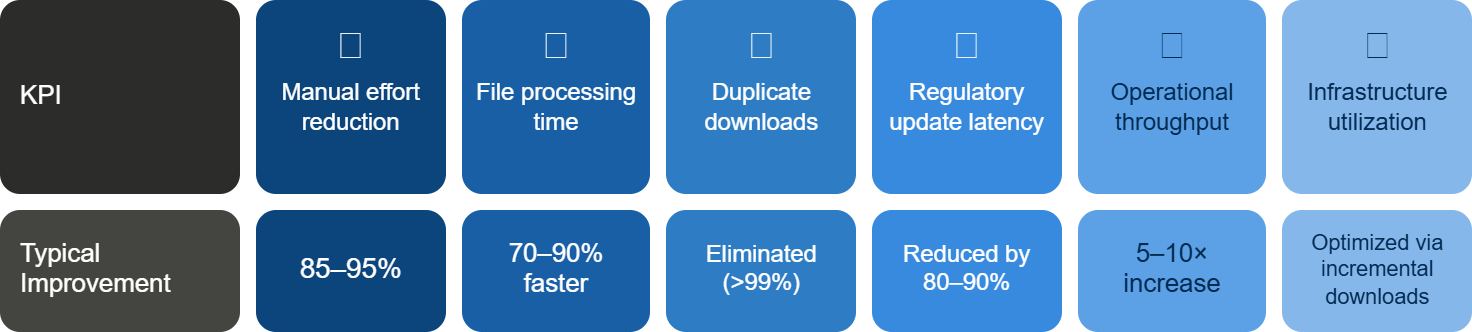
7. ROI
Major outcomes for engagement include:
- Return on investment within 6–12 months
- Significant reduction in labor costs tied to regulatory monitoring and document collection
- Lower storage and bandwidth costs through intelligent incremental processing
- Improved analyst productivity from timely, validated regulatory information
- Faster delivery of updated well information to commercial information platforms
8. Project Execution Timeline
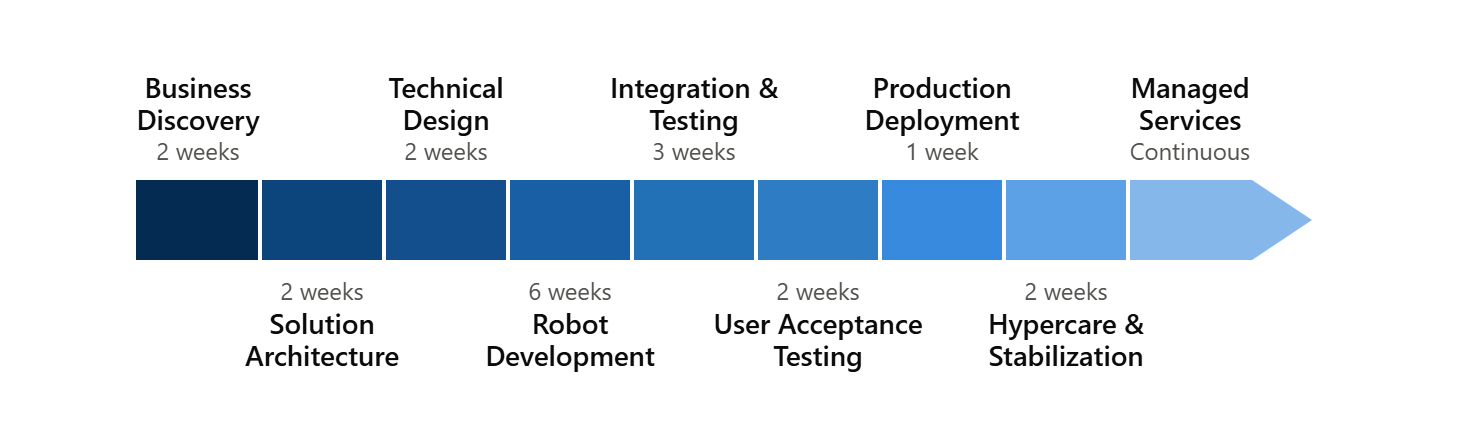
9. Project Hurdles and Lessons Learned
Key Challenges
Government websites came with a genuinely diverse mix of technologies, authentication methods, and publication mechanisms, which meant a one-size-fits-all automation strategy was never going to work — the framework had to flex per source. Layouts and navigation structures changed periodically across agencies, requiring ongoing maintenance and crawler designs built to absorb change rather than break on it. Getting incremental detection right — avoiding duplicate downloads without ever missing a genuine update — took robust, carefully tested logic. Integrating Java libraries into the automation framework introduced its own dependency management and performance considerations that needed careful handling. And keeping robot execution stable across this many external, uncontrolled data sources required proactive infrastructure monitoring rather than reactive firefighting.
Lessons Learned
Incremental download strategies turned out to be one of the highest-value design decisions in the build — the reduction in processing time, network traffic, and storage cost was substantial and immediate. Modular crawler architecture again proved its worth for maintainability as external websites evolved over time. Centralized scheduling and monitoring made a measurable difference in reliability once the automation was running dozens of sources at enterprise scale. Extending the RPA platform with Java libraries opened up flexibility for specialized business requirements that the platform didn’t handle natively. And continuous monitoring of RoboServer resource utilization proved essential for sustaining a high-volume automation workload over the long run — this isn’t the kind of system you deploy and stop watching.
10. Best Practices Implemented
- Modular and reusable robot architecture
- Incremental file detection to eliminate duplicate processing
- Automated exception handling with configurable retry logic
- Centralized robot scheduling and execution management
- Secure handling of authenticated web sessions
- Comprehensive logging and audit trails
- Performance monitoring of RoboServer CPU and memory utilization
- Configurable extraction rules to accommodate changing government websites
- Structured change management and proactive production support
11. Security & Compliance
Solution was implemented inline with enterprise operational governance & security standards, including:
- Secure management of authentication credentials and web sessions
- Role-based access to automation infrastructure and management consoles
- Comprehensive audit logging for robot execution and file processing activities
- Version-controlled robot development, deployment, and change management
- Secure integration with enterprise databases and document management platforms
- Controlled production deployment and release management procedures
- Compliance with enterprise information security, operational governance, and quality management practices
12. Business Value Delivered
TechTiera delivered a highly scalable intelligent automation platform that transformed the client’s regulatory data acquisition process for U.S. oil and gas operations. By automating the monitoring of government websites and FTP repositories, implementing intelligent incremental downloads, and integrating validated information into enterprise systems, the solution dramatically reduced manual effort, accelerated data availability, and improved operational reliability. Beyond the technical build, TechTiera provided ongoing managed services, production monitoring, and continuous optimization — giving the client a resilient, efficient, future-ready data acquisition capability supporting mission-critical energy market intelligence and analytics.